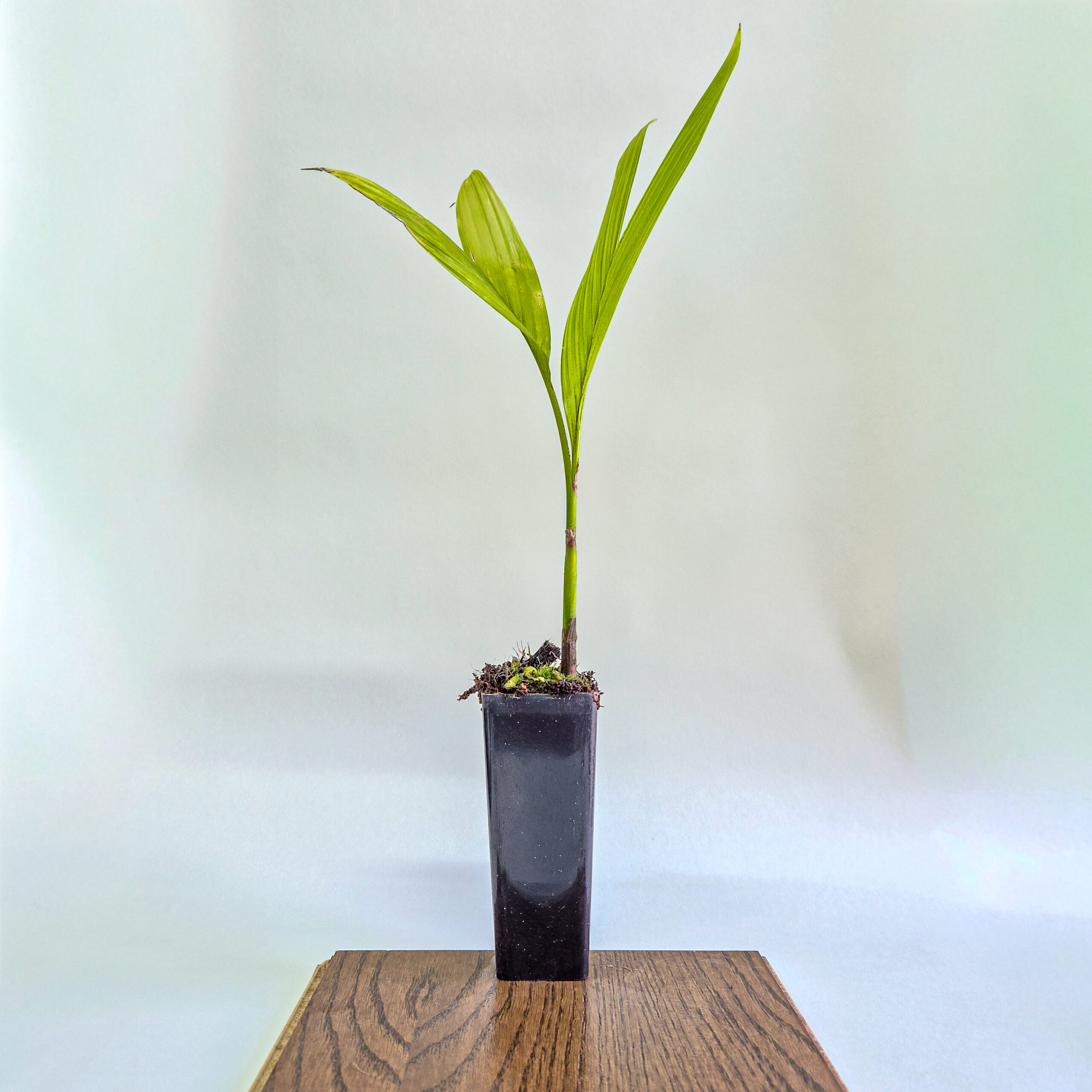
The Betel Nut Palm is an elegant tropical evergreen with a slender, ringed trunk, lush feather-like fronds and colourful clusters of fruit.
The Story of the Betel Nut Palm
Officially known as Areca catechu, this distinctive palm likely originated in the Philippines. People have cultivated it for thousands of years, carrying it throughout South-East Asia, the tropical Pacific, and parts of East Africa. As a result, it now plays a key role in the cultural and ceremonial traditions of these regions.
Its common names include Betel Nut Palm, Areca Nut Palm, Betel Palm, Pinang Palm, Catechu Palm, Betel Tree, Indian Nut Palm, Indian Nut and Areca Palm. The last of these can confuse, as “Areca Palm” is also commonly used for the unrelated Chrysalidocarpus lutescens.
A Graceful Tropical Feature
This palm grows to approximately 10 metres and develops a smooth, upright trunk marked by neat leaf scars. Its arching, pinnate fronds form a handsome crown above the trunk. As the palm matures, it produces branched clusters of green fruits that ripen through yellow, orange, and red.
This palm makes a striking ornamental feature for tropical and warm subtropical gardens. It stands out when you plant it where people can admire its narrow silhouette, structured trunk, and colourful fruit. For this reason, many gardeners choose prominent locations for it.
Growing the Betel Nut Palm
Choose an open, sunny position with fertile, well-drained soil. Keep the soil consistently moist, especially while the plant is young, but do not let the roots remain waterlogged. Warmth, humidity, and protection from drying winds support healthy growth. Therefore, gardeners should monitor conditions closely to ensure success.
Because this plant does not tolerate drought or frost, it is best suited to reliably warm climates or a protected microclimate. If you live outside tropical regions, you can grow young specimens in containers and move them to shelter during cold weather. In this way, even gardeners in cooler areas can enjoy the Betel Nut Palm.
A Palm with Ceremonial History
Traditionally, people wrap its nuts in the leaves of the
Paan, or Betel Pepper, Plant (Piper betle), with powdered lime to prepare betel quid. This practice serves ceremonial and cultural purposes rather than food use. As a result, the Betel Nut Palm holds deep meaning in many communities.
Please note: Grow this plant only for ornamental purposes.